
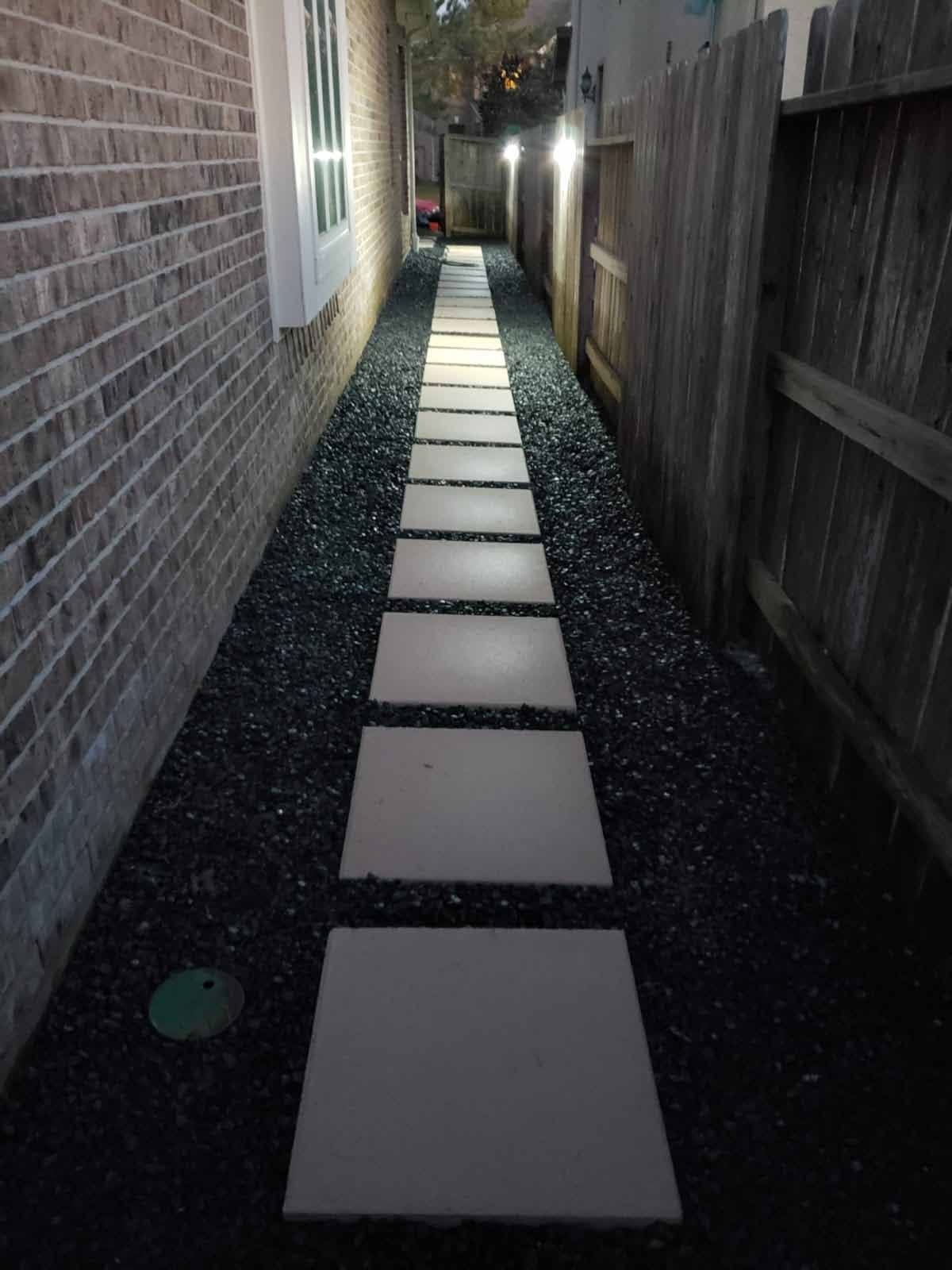
Landscape lighting design in Houston is about more than a row of stakes along the front walk. A real plan decides what you want to see after dark, what you want to leave in shadow, and how to put light where it is needed without glare in your eyes or your neighbor's windows. It also has to hold up to humidity, downpours, sprinkler spray, and live oak roots that keep shifting the ground around every fixture.
Texas Urban Elements draws lighting plans as part of our Houston landscape design service, and our crew carries them through landscape lighting installation. Because the same team plans the beds, walls, patios, and drainage, fixtures are placed around what will actually be built, not tacked on at the end. Our lighting designers are Hunter Lighting certified.
What's under it · tap a layer
Hardwood mulch. A layer over the soil that holds moisture, evens out soil temperature and keeps weeds down.
01
Signs Your Yard Needs a Landscape Lighting Design
Most homeowners call about lighting for one of three reasons: the backyard goes unused after sunset, the house looks dark and uninviting from the street, or the existing lights are failing one by one. Solar stakes and boxed kits tend to fade, tip over during mowing, and fill a walkway with glare instead of usable light.
- Steps, walks, or grade changes are hard to see at night
- The patio is too dark to enjoy in summer, when evenings are the only comfortable time outside
- Large trees and the architecture of the house disappear after dark
- Existing fixtures flicker, corrode, or leave dead zones
- Lights shine into bedrooms or across the property line
02
How a Low-Voltage Lighting Plan Works
Residential landscape lighting typically runs on low voltage. A transformer connected to a weatherproof outdoor outlet steps household power down to roughly 12 to 15 volts, and direct-burial cable carries it to the fixtures. Low voltage is safer around soil and water, and fixtures can be shifted as plants grow.
The design work lives in the details. The plan sets the transformer size and location, the number of wire runs, and how fixtures are grouped so each one gets steady voltage. Long runs on undersized cable lose voltage, which shows up as dim lights at the end of the line. A hub layout, where several fixtures connect at one central splice point, keeps brightness even across the yard.
Houston conditions shape the choices too. Splices must be sealed against moisture, fixtures must be rated for wet locations, and cable is routed away from future dig zones, irrigation trenches, and tree roots. Any new outlet or circuit for a transformer is coordinated with a licensed electrician and permitted where required.
03
Lighting Techniques We Layer Into the Plan
Good lighting uses several techniques at low intensity rather than one bright source. A typical plan blends:
We usually specify warm color temperatures for residential work, because cool white light makes plantings and stone look flat and harsh.
- Path lights that throw soft pools of light onto walks without pointing at your eyes
- Uplights at the base of live oaks, palms, or crape myrtles to reveal trunk and canopy
- Wall washing to light brick, stone, or stucco evenly
- Grazing, with a fixture close to a textured wall to bring out its surface
- Downlights mounted high in trees or on structures for a moonlight effect
- Step and hardscape lights set into risers, walls, and seat caps
04
Our Landscape Lighting Design Process
Lighting is easiest to plan in person, so a Home Scout visits every property before a proposal is written.
- Free discovery call to talk through what you want lit and why
- On-site consultation with a Home Scout, ideally late in the day so the property can be seen near dusk. The $150 work scope fee is credited to the project if you move forward
- CAD lighting plan showing fixture types, locations, beam direction, transformer placement, and wire routes
- Optional 3D renderings of evening views, a $497 upgrade credited toward the build
- Itemized written proposal, with the price we quote being the price you pay
- Installation by our crew, followed by a 72-hour post-completion walkthrough
05
Fixture Materials, Lamps, and Controls
Fixtures come in aluminum, brass, and copper. Brass and copper cost more but hold up better in Gulf Coast humidity, where painted aluminum can corrode and peel. LED lamps are now standard and draw far less power than old halogen bulbs, so a single transformer can run more fixtures.
Controls range from a photocell that switches lights on at dusk to astronomical timers and zone control, so the front yard and backyard can run on different schedules. We size transformers with spare capacity so you can add fixtures later as plantings fill in.
06
Landscape Lighting Cost Factors in Houston
Lighting cost is driven by fixture count and quality, the number of transformers, the length of wire runs, and how difficult it is to bury cable. Crossing under an existing patio or driveway takes sleeving or boring, while trenching through open beds is simple. Lighting built into walls and steps during construction costs less than retrofitting it later.
Our ballpark price tool gives you a quick range, and the proposal you receive is itemized by fixture and run.
07
Lighting Problems We Fix
The calls we get most often: lights that dim toward the end of a run because the cable was too small, splices taped and buried that corroded within a year, fixtures knocked over by mowers, and floodlights aimed straight into a neighbor's bedroom. Each one traces back to a missing plan. Laying out runs, splices, and aim angles on paper first avoids nearly all of them.
08
Landscape Lighting Design That Fits the Rest of Your Yard
Lighting works best when it is planned alongside the hardscape. If you are adding outdoor steps, riser lights can be set during the build. A water feature looks completely different at night with a submersible light. Uplighting also shows off the trees and beds in a garden design, and it is central to most curb appeal landscaping projects.
Texas Urban Elements is one team from design through installation, with no subcontractor hand-offs. We have served Houston and its suburbs since 2016, and every proposal is itemized with no surprise charges.
Landscape Lighting Design Questions
Is low-voltage landscape lighting safe around sprinklers and pools?
Low-voltage systems are much safer around water than line-voltage lighting, which is why they are standard in residential landscapes. The transformer plugs into a protected outdoor outlet, and the cable beyond it carries reduced voltage. Fixtures still need wet-location ratings and sealed splices, and pool-area lighting has its own code rules that we coordinate with a licensed electrician.
How many landscape lights does a typical yard need?
There is no set number. A front yard might need a handful of path lights, a few uplights on trees, and wash lights on the facade, while a large backyard with a patio, kitchen, and pool needs more. The goal is balance, not brightness. We count fixtures by what each one needs to show, then confirm the layout during design.
What color temperature is best for landscape lighting?
Most residential landscapes look best with warm white light, similar to a soft incandescent glow. It flatters brick, stone, and foliage and feels inviting. Cooler light can work on certain plantings or for a moonlight effect from high in a tree, but mixing too many color temperatures makes a yard look patchy. We keep the palette consistent across the plan.
Can landscape lighting be added after the patio is built?
Yes. Most fixtures go in beds and lawn areas, which are easy to trench. Crossing under existing concrete or pavers takes boring or sleeves, and lights built into walls or steps are harder to add after the fact. If you are planning new hardscape, it is worth putting conduit and wall lights into the design now.
Will landscape lighting raise my electric bill much?
With LED fixtures, the added cost is usually modest because each lamp draws only a few watts. A photocell or timer keeps lights from running all night unless you want them to. The bigger factor is fixture count and run time. We size the transformer to the actual load so the system runs efficiently.
We design and we build. When the plan is approved, the same team handles landscape lighting installation in Houston.
Related Services in Houston
- Landscape Lighting Installation Houston
Low-voltage path, uplight, and wall lighting installed with buried wire, transformers, and timers.
- Water Feature Installation Houston
Fountains, bubblers, and pondless water features designed into the patio or garden plan.
- Patio Design Houston
Outdoor living surfaces designed with proper grading, drainage, and material selection for Houston's climate.
- Outdoor Living Space Design Houston
Complete outdoor environments combining patios, kitchens, fire features, and shade structures into one plan.
- Hardscape Design Houston
Driveways, walkways, walls, and paver surfaces designed with proper base and drainage for Houston soil.
- Outdoor Kitchen Design Houston
Kitchen layout, utility coordination, and drainage planning for outdoor cooking spaces that last.
Landscape Lighting Design is part of our Landscape Design Houston services. Texas Urban Elements is a landscape designer Houston TX that designs and builds every part of the yard.
Need an Assessment?
We assess your yard and provide a permanent solution. Professional project consultation. A Home Scout personally visits every property.
What you get
- A Home Scout on siteA trained scout walks and measures every property before a proposal is written.
- Itemized written proposalPriced line by line, and we price what we quote.
- One team, every tradeNo subcontractor hand-offs between drainage, base and finish.
- 72-hour walkthroughWe come back after completion to check the work with you.
- Backed by guaranteesDrainage Performance Guarantee and a structural warranty on hardscape.
Let's Get Started
Don't wait until the problem gets worse. Schedule your professional project consultation today.
For a full overview of landscape designer options in Houston, see our Landscape Designer Houston page.