
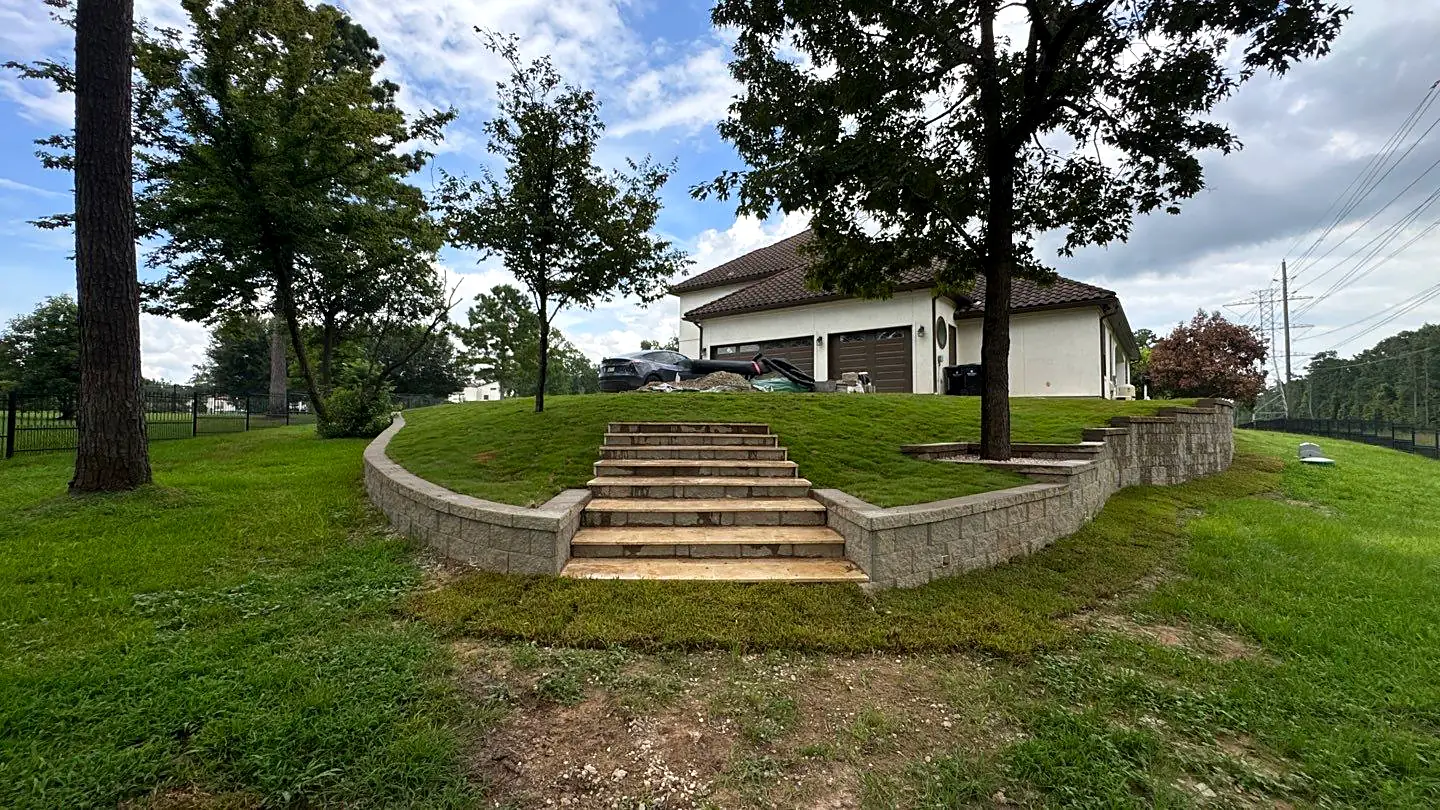
Stone Retaining wallA wall built to hold back soil where the ground level changes. in Houston give a slope a finished, settled look that few other materials match, especially on established lots in Memorial, Bellaire, and West University Place where the house already has brick or stone. The catch is that stone is heavy, irregular, and set by hand, so the parts you never see decide whether the wall stays straight.
We build stone walls as structural walls first and decorative features second. That means a buried base, a gravel drainage zone, and compacted backfill under and behind every stone, with the stone itself chosen and laid to suit your home. The work is part of what we do as a retaining wall contractor in Houston, and it follows the same rules as our block walls, just with more hands on each course.
What's under it · tap a layer
Wall block cap. A wall built to hold back soil where the ground changes level. A wall that can't drain will eventually move.
01
When a Stone Retaining Wall Fits Your Property
Stone is the right pick when the wall is a visible part of the landscape and you want it to read as permanent. It suits wooded lots under live oaks and pines, older homes with brick or stone facades, and front yards where the wall is the first thing guests see.
Stone also makes sense for walls that curve, step, or wrap around a planting bed, because every piece can be fit to the line. For very tall walls or walls carrying heavy loads above them, we often pair a block or concrete core with a stone face so you get the look without asking loose stone to do structural work it is not suited for.
- You want the wall to match stone already on the house or columns
- The wall is in a front yard or near an entry where appearance matters most
- A short to medium grade change needs holding on a wooded or garden lot
- You are replacing a failed timber wall and want something that will not rot
02
Dry-Stacked vs. Mortared Stone Retaining Walls
A dry-stacked wall holds by weight, friction, and batter. Thick stones are laid without mortar, each one tipped slightly back into the slope, with long through stones tying the face into the backfill. Because the joints are open, a dry wall can flex a little as clay moves without cracking. It is best kept to lower heights on residential lots.
A mortared wall sets stone on a reinforced concrete FootingThe widened base at the bottom of a wall, column or structure that spreads its load into the ground., either as solid masonry or as a veneer over a block or poured core. Mortar makes the wall rigid and allows a cleaner face and taller heights, but it also seals the joints. That means Weep holeA small opening near the base of a wall that lets trapped water escape. In practice: A retaining wall that cannot drain is a wall that will eventually move. TUE details always show how water leaves the back of the wall. and a gravel drainage zone are not optional, and the footing has to be sized so the clay underneath cannot crack the whole wall when it swells.
Either way, drainage behind the stone is the same as on any structural wall: washed gravel, filter fabric against the clay, and a perforated pipe at the base carried to an outlet.
03
How We Build a Stone Retaining Wall
Stone work rewards patience. Here is how a typical wall comes together on site.
- Stone selection: we review samples with you and confirm color, size, and finish before ordering.
- Layout: the wall line, height, and steps are staked and strung so you can see the footprint before any digging.
- Footing: for dry walls, a compacted Base courseThe layer of compacted crushed stone or road base placed over the subgrade to support paving. below grade; for mortared walls, a reinforced concrete footing.
- Base course: the largest stones go in first, bedded fully so they cannot rock.
- Building up: each course is set with batter, joints broken over the stones below, and through stones placed at regular intervals.
- Drainage: washed gravel and a perforated pipe rise with the wall, wrapped from the clay by filter fabric.
- Capstones: flat caps are set in mortar or adhesive and pitched slightly to shed water.
- Cleanup: mortar haze is washed off, the site is graded, and we return for a 72-hour post-completion walkthrough.
04
Stone Choices That Hold Up in Houston
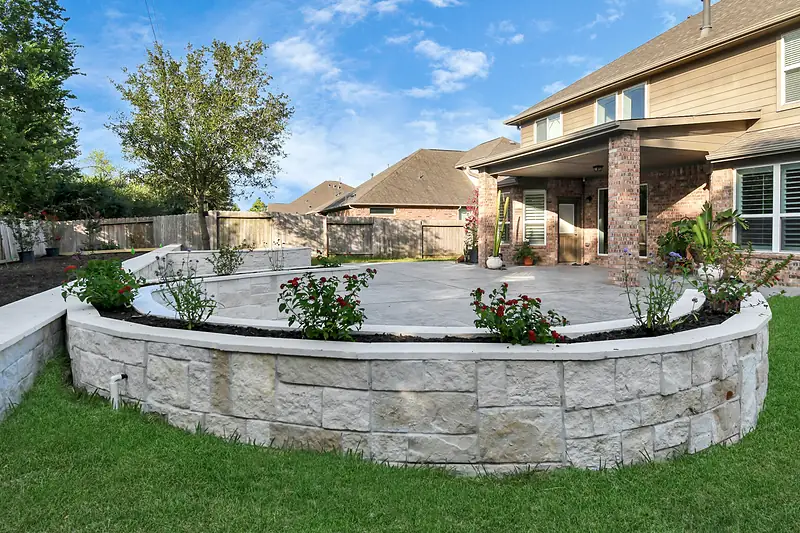
Texas limestone is the most common choice for local stone walls. It comes in chopped block, sawn, and tumbled finishes and in creams, grays, and buff tones that stay cooler underfoot and in the sun than dark stone. Sandstone offers warmer reds and browns, and granite or river rock boulders suit a natural, rugged look.
FlagstoneFlat, irregular or cut slabs of natural stone used for patios, walks and wall caps. is popular for caps because it gives a broad, flat top for sitting or setting pots. Manufactured stone veneer over a concrete or block core is another option.
Limestone is softer and more porous than granite, so under oaks and pines it can stain from tannins and needles. A breathable penetrating sealer helps, and we will tell you honestly whether sealing is worth it for your stone and setting.
05
Stone Retaining Wall Cost Factors in Houston
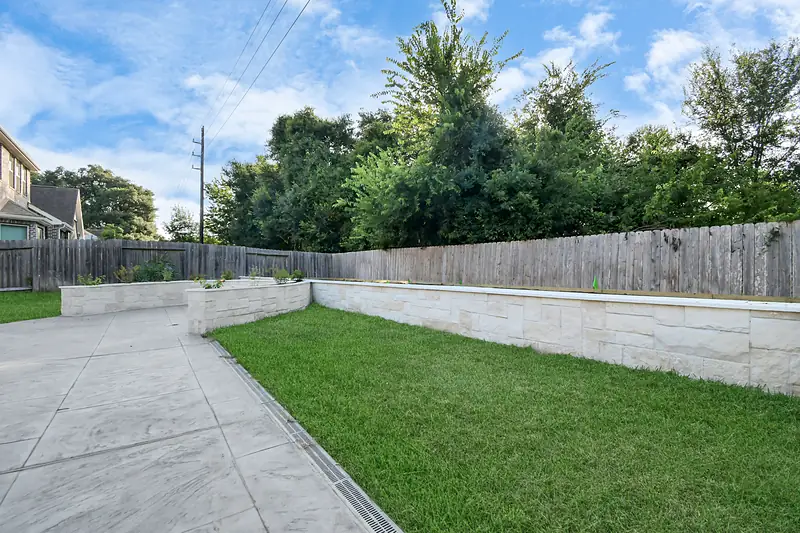
Stone walls cost more per square foot of face than block, mostly because of hand labor. Every stone is lifted, shaped, and fit, and a mortared wall adds a concrete footing and masonry time on top of that.
The main drivers are the stone type and how far it travels, the wall height and thickness, solid stone versus veneer over a core, the footing size, how many corners and steps there are, and access for pallets and equipment. Caps, lighting, and any removal of an old wall add to the scope. For an early number, the ballpark price tool gives you a range before a site visit.
06
Problems We See on Stone Walls Built Wrong
The fastest way to ruin stone is to stack thin pieces face-out with dirt behind them. The wall looks fine from the street, but there is no depth, no through stones, and no drainage, so the first wet season pushes it over.
We also see mortared walls with no weep holes, footings poured directly on loose clay, veneer glued to a backing that was never meant to hold soil, and stones bedded on dirt instead of compacted base. Stair-step cracks in the mortar and white efflorescence on the face are both signs of water trapped behind the stone. Smaller issues like loose caps or eroded joints can often be handled through masonry repair, but a wall with no drainage usually needs to be rebuilt.
07
What Pairs Well with a Stone Retaining Wall
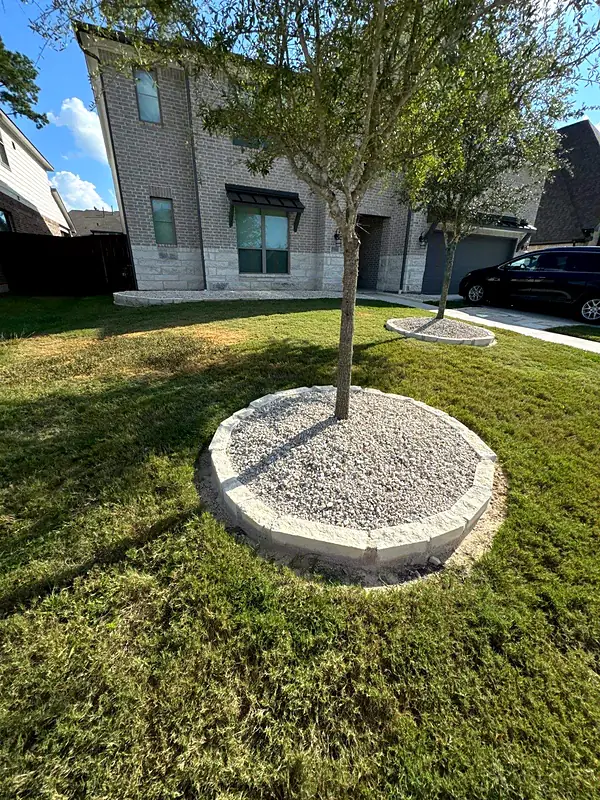
Stone walls tie naturally into other masonry. We often match a wall to stone masonry columns at a gate or entry, carry the same stone into outdoor step construction where the wall changes grade, or use it as the base of a fire feature.
Low-voltage lights tucked under the caps make a stone face stand out at night, and landscape lighting installation is easiest to plan before the caps go on. For walls under about 3 feet that mainly frame beds, our landscape retaining walls page covers lighter options.
08
Why Homeowners Choose Us for Stone Retaining Walls
One team handles the excavation, the drainage, and the stone setting, so the crew that buries the pipe is the crew that lays the face. A Home Scout visits your property before any proposal is written and looks at the slope, the soil, and how water reaches the wall.
You get an itemized written proposal and our price-what-we-quote guarantee. Stone walls are covered by our structural warranty on hardscape, and you can see completed work in our portfolio.
Stone Retaining Walls Questions
Are stone retaining walls stronger than block walls?
Not automatically. Strength comes from the base, batter, drainage, and reinforcement, not the material alone. Segmental block is more predictable for tall structural walls because the units interlock and work with GeogridA plastic mesh laid in layers behind a retaining wall and buried in the backfill to tie the soil mass to the wall.. Stone performs very well at lower heights and as a veneer over a block or concrete core. We choose the structure for the load first, then the face for the look.
How tall can a dry-stacked stone wall be?
On residential lots, dry-stacked walls are usually kept to about 3 feet or less. Above that, the stone needs to be very thick and the batter steeper, and a mortared wall, a reinforced core, or a series of terraced walls is usually a better fit. Walls that need permits or carry loads above them follow stamped plans from a licensed P.E. when required.
Do stone walls need drainage behind them?
Yes. Dry joints let some water pass, but Expansive clayClay soil that swells when wet and shrinks when dry. Much of the Houston area sits on it, and it affects foundations, paving and drainage design. In practice: Keeping soil moisture around a slab foundation steady, without ponding or bone-dry spells, is part of good drainage design here. holds water long after a storm, and saturated clay pushes hard on any wall. Every structural stone wall we build gets washed gravel behind it, filter fabric against the clay, and a perforated pipe at the base. Mortared walls also get weep holes so water cannot build up behind the sealed face.
Can you add stone veneer to an existing retaining wall?
Sometimes. If the existing concrete or block wall is plumb, sound, and draining, we can add a stone face with a proper ledge or footing to carry the weight. If the wall is leaning, cracked, or shows water staining, cladding it only hides the problem. We assess the wall first and tell you whether veneer or a rebuild makes sense.
Related Services in Houston
- Stone Masonry Houston
Custom stonework for columns, accent walls, planters, and outdoor structures built to hold up in Houston's climate.
- Retaining Wall Design Houston
Slope management walls sized and specified for Houston's expansive clay soils.
- Retaining Wall Installation Houston
New retaining walls built with proper batter, base embedment, and drainage aggregate for Houston's expansive clay.
- Block Retaining Walls Houston
Segmental block walls with geogrid reinforcement for Houston properties that need structural holding capacity.
- Retaining Wall Repair Houston
Assessment and correction of leaning, cracking, or bulging retaining walls before full failure occurs.
- Landscape Retaining Walls Houston
Lower decorative walls that terrace slopes, define planting beds, and add structure to outdoor spaces.
Stone Retaining Walls is part of our Retaining Wall Contractor Houston services. Texas Urban Elements is a landscape designer Houston TX that designs and builds every part of the yard.
Need an Assessment?
We assess your yard and provide a permanent solution. Professional project consultation. A Home Scout personally visits every property.
What you get
- A Home Scout on siteA trained scout walks and measures every property before a proposal is written.
- Itemized written proposalPriced line by line, and we price what we quote.
- One team, every tradeNo subcontractor hand-offs between drainage, base and finish.
- 72-hour walkthroughWe come back after completion to check the work with you.
- Backed by guaranteesDrainage Performance Guarantee and a structural warranty on hardscape.
Texas Urban Elements job photos
Stone Retaining Walls jobs in Houston
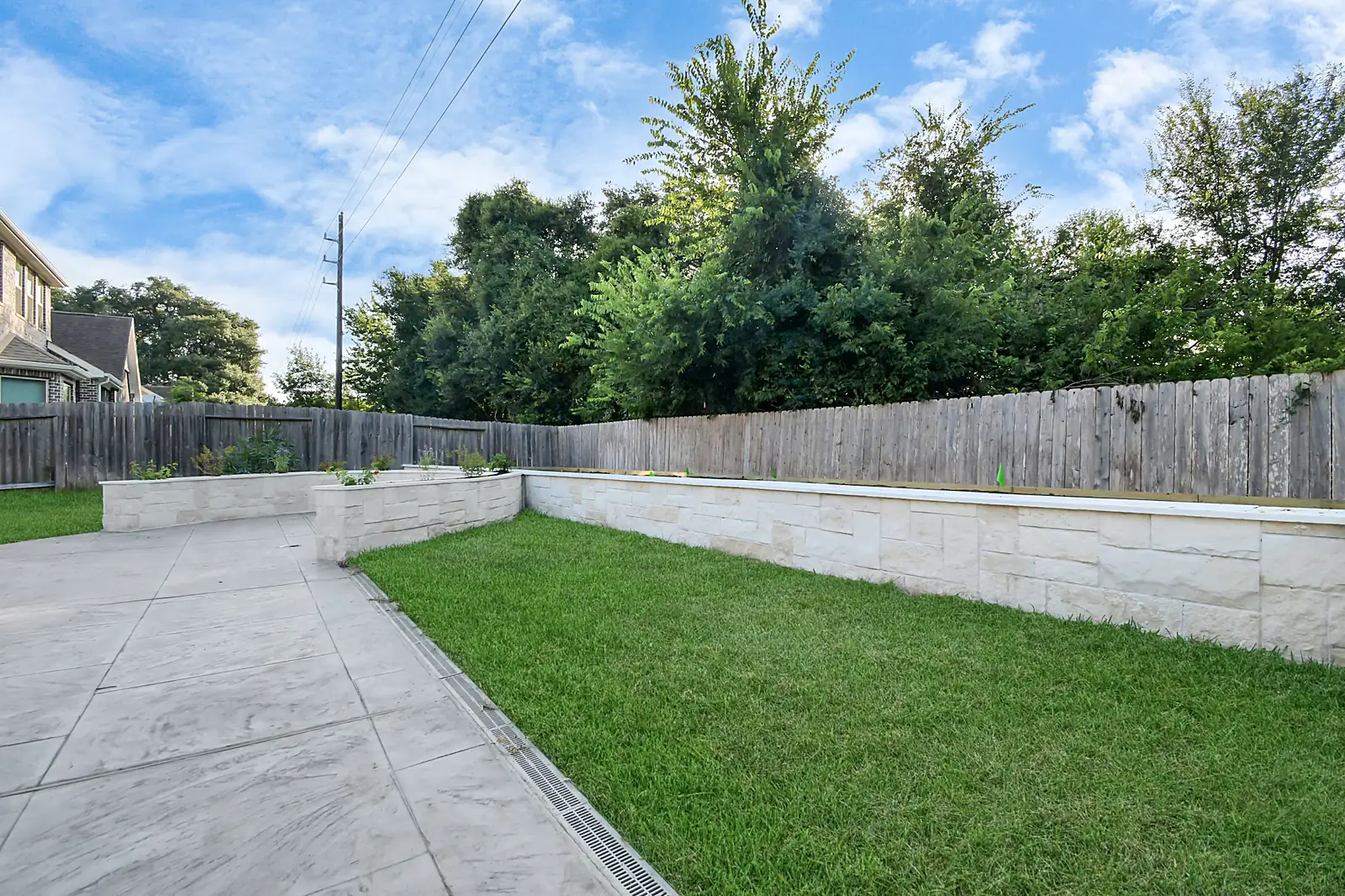
Photos from our own projects, edited for the web. Tap a thumbnail to see it larger.
Let's Get Started
Don't wait until the problem gets worse. Schedule your professional project consultation today.
For a full overview of retaining wall contractor options in Houston, see our Retaining Wall Contractor Houston page.